Our Investment Philosophy
Every family's financial journey is unique. If our investment philosophy resonates with you, we'd welcome the opportunity to learn more about your goals, your values, and the life you're working to build. A discovery meeting is simply a conversation to explore your situation, answer your questions, and determine whether we're the right fit to help you build and steward your Army of Assets. There is no cost, no obligation, and no pressure—just an opportunity to get to know one another.
-
At the foundation of our investment philosophy is a simple belief: wealth comes from ownership. Throughout history, lasting wealth has been created by owning productive assets—businesses, real estate, farmland, and other enterprises that produce goods, services, and cash flow. These assets create value because they participate in human innovation, economic growth, and, importantly, inflation. As the cost of goods and services rises over time, productive assets often have the ability to increase prices, rents, earnings, and cash flow. Instead of spending a lifetime fighting inflation, owners have the opportunity to benefit from it.
Not everything you own serves that purpose. We think of every dollar according to its job. Productive assets are designed to grow wealth over the long term. Lifestyle assets provide enjoyment and support the life you want to live. Liquidity assets—cash, money markets, and short-term, high-quality fixed income—have a different assignment altogether. They are not intended to create wealth. Their role is to provide stability, flexibility, and readily available spending money when you need it.
This is one of the ways our philosophy differs from conventional portfolio management. Rather than maintaining a permanent allocation to bonds because they're expected to generate returns, we hold liquidity assets to fund known spending needs and provide the confidence to remain owners through inevitable market volatility. If a client needs $40,000 per year from a $1 million portfolio, we may reserve several years of planned withdrawals in liquidity assets. That reserve isn't there to outperform the market. It's there to ensure you never have to sell productive assets at an inopportune time. By separating short-term spending from long-term ownership, we allow the assets that have historically created wealth—and turned inflation from an obstacle into an ally—to continue compounding over time.
-
We identify productive assets by starting with problems, not products. Every enduring investment opportunity begins with a real need in the marketplace—a constraint, inefficiency, shortage, or demand that must be addressed. Rather than chasing trends, we seek to understand where genuine economic problems exist because solving meaningful problems is what creates lasting value.
Once we understand the problem, we study the industries where that problem exists. Some industries are better positioned than others because they operate at the center of long-term economic demand. We want to understand the forces driving that demand, whether the need is likely to persist, and whether the industry provides opportunities for disciplined businesses to create value over many years.
Within those industries, we look for the companies with the greatest ability to solve the problem. That advantage may come from financial strength, operational excellence, intellectual property, efficient scale, exceptional management, or another durable competitive advantage. The businesses we own are not simply participants in an industry—they are the organizations best equipped to meet an important and growing need.
A productive asset must also produce income. Solving problems should ultimately generate cash, and businesses that consistently create value should generate durable and growing free cash flow. That cash flow may be distributed directly to owners through dividends or share repurchases, or it may be reinvested to expand the business and meet increasing demand. Either way, the asset is producing an economic return.
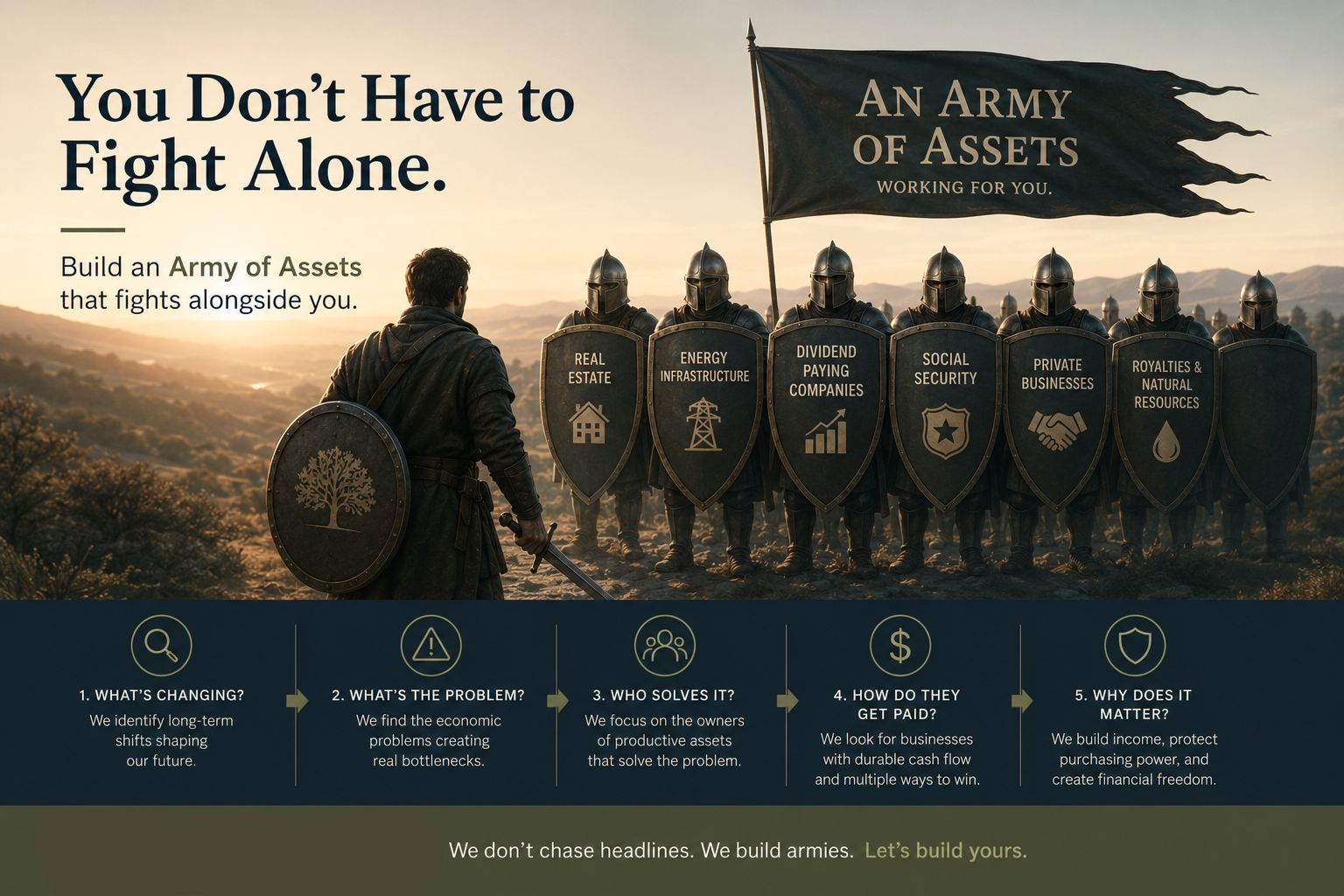
Our goal is not simply to own productive assets, but to own a collection of productive assets that work together—each solving important problems, generating cash, and strengthening the others over time. We call this your "Army of Assets".
-
The way we build an Army of Assets is surprisingly simple. We recruit one productive asset at a time. Every soldier has one job: produce income or protect income. Some soldiers produce rent. Some generate business profits. Some pay dividends. Some create royalties. Some provide guaranteed lifetime income, like Social Security. This soldier is unique because its value increases when you wait to deploy it between the ages of 62 and 70. Others reduce expenses or protect the rest of your financial position from loss. They don't all fight the same way, but they all strengthen your financial position. That's why diversification matters. A strong army isn't made up of identical soldiers; it's made up of different units, each contributing its own strength when it's needed most.
This also changes how we think about assets. An asset isn't simply something you own. A productive asset creates economic value that is independent of your daily labor. It keeps working whether you're on vacation, spending time with your family, or eventually unable to work. Some assets produce cash flow today. Others increase future income, lower future expenses, or provide stability when other sources of income weaken. The common denominator is that they reduce your dependence on a single paycheck and increase your financial resilience over time.
The goal, then, isn't to accumulate more possessions. It's to recruit more productive assets. Each one that joins your Army of Assets stands beside you, carrying part of the financial load. Over time, your paycheck is no longer the only thing supporting your household. Instead, you're surrounded by an army of productive assets, each serving a different role, each making a unique contribution, and together creating a financial life that is stronger, more resilient, and better positioned to endure whatever the future may bring. This is faithful stewardship in action: not merely preserving what you've been entrusted with, but putting it to productive use so that it can multiply its impact over time.
-
What is your Army's mission?
An Army of Assets is built for more than accumulation. It exists to accomplish a mission.
Its first mission is to provide for you and your family with confidence and dignity. As productive assets grow and generate income, they reduce your dependence on a single paycheck and strengthen your ability to weather life's uncertainties. Over time, your Army of Assets works alongside you, creating greater resilience, flexibility, and peace of mind throughout retirement and every stage of life.
Its mission extends beyond your own lifetime. A well-built Army of Assets creates opportunities for your children instead of burdens. It allows you to bless future generations with more than financial resources by creating the time, stability, and margin to pass along wisdom, values, and the habits of faithful stewardship. As Scripture reminds us, "A good man leaves an inheritance to his children's children." An inheritance is not merely wealth to be transferred, but stewardship to be entrusted.
An Army of Assets also creates the freedom to be generous. When your family's needs are secure, generosity becomes an opportunity rather than a sacrifice. Whether supporting your church, helping a neighbor, investing in your community, or meeting an unexpected need, productive assets expand your capacity to serve others without compromising your own financial security.
Ultimately, the purpose of ownership is not simply to become wealthier. It is to create the capacity to faithfully serve your family, your community, and future generations. Wealth is a means, not the mission. Stewardship is the mission. Our role is to help you build and steward an Army of Assets that faithfully carries out that mission for decades to come.